Companion to Chapter 11. Chapter 11 teaches Prep for AI — the three-part upstream investment (AI data schemas, verified answers, AI instructions) that shifts disambiguation from every question to a once-per-model configuration. AI data schemas deselect fields Copilot should not see; verified answers pin canonical responses to high-stakes recurring questions; AI instructions carry the analyst’s mental glossary in a Copilot-readable brief. Combined with the confirmation-turn pattern (a follow-up prompt asking Copilot to restate the measure and grain it used), the chapter turns Copilot Q&A from a per-question guessing game into a defensible interface. This page carries what the book cannot: curated further reading beyond Appendix C on Prep for AI and semantic-model hygiene, a five-question self-check quiz on the three components, and a hands-on activity that configures Prep for AI on a sandbox model.
Use the further reading to see the vendor documentation for each component; the surface changes but the three-component structure is stable. Use the quiz to move the components into vocabulary. Use the activity to see one hour of upstream configuration turn two clean answers and three failures into four clean answers plus one correct refusal.
Further reading
Vendor docs and community resources beyond the book’s own bibliography (Appendix C, updated in errata) on the Prep-for-AI surface and the semantic-model discipline it composes with.
- Microsoft Learn — Prep data for AI overview. The vendor documentation entry point for the three-component Prep-for-AI workflow. Read this first to see the current surface for each component. Free at learn.microsoft.com/power-bi/create-reports/copilot-prepare-data-ai.
- Microsoft Learn — AI data schemas. The specific configuration surface for restricting which tables, columns, and measures Copilot considers. Documents the «Simplify data schema» dialog Ch 11 refers to. Free at learn.microsoft.com/power-bi/create-reports/copilot-prepare-data-ai-data-schema.
- Microsoft Learn — Verified answers. The configuration surface for pinning canonical responses to matched trigger phrases. Documents the trigger-phrase mechanism and the visual-response payload. Free at learn.microsoft.com/power-bi/create-reports/copilot-prepare-data-ai-verified-answers.
- Microsoft Learn — AI instructions. The configuration surface for the analyst’s mental-glossary brief — free-text guidance the model reads on every question. Documents the format expectations and best-practice examples. Free at learn.microsoft.com/power-bi/create-reports/copilot-prepare-data-ai-instructions.
- Norman, D. (2013). The Design of Everyday Things (rev. ed.). Basic Books. The design-thinking classic underneath the confirmation-turn pattern. Norman’s chapters on affordances and feedback are the theoretical basis for «always confirm the model’s interpretation before acting on it» — the same pattern voice interfaces («Did you mean Seattle or San Jose?») borrowed from Norman a decade ago. Chapter 1 for the framework; Chapter 5 for the feedback discipline.
Last curated: 2026-07-18. Reviewed quarterly. Suggestions welcome via the Feedback page.
Self-check quiz
Five questions on Ch 11’s load-bearing concepts. Answer them out loud before opening the reveal.
-
Q1. Name the three Prep-for-AI components and, in one line each, what specific problem each solves.
Show answer
AI data schemas — deselect ambiguous, internal-use, or staging fields so Copilot cannot pick them (solves: field-name collisions like three fields containing the word revenue). Verified answers — pin canonical responses to trigger phrases so the same question returns the same visual every time (solves: nondeterminism on high-stakes recurring questions). AI instructions — the analyst’s mental glossary in a Copilot-readable brief (solves: disambiguations that field names alone cannot carry, like «when someone says revenue, they mean net revenue»).
-
Q2. Ch 11 argues Prep for AI is a one-time upstream investment. Why is this different from per-question verification?
Show answer
Per-question verification (like the confirmation turn) is per-artifact: the analyst does it every time a question is asked. Prep for AI is per-model: the analyst configures it once, and every question against that model benefits. The economics are asymmetric — roughly one hour of Prep-for-AI configuration replaces indefinite hours of per-question confirmation turns. The trade-off: Prep for AI requires model-author permission and semantic-model literacy, which not every analyst has. When an analyst does have that access, Prep is the highest-leverage move in the chapter.
-
Q3. Ch 11 introduces the confirmation turn as the cheapest verification move for data questions. What is it, and where did the pattern originate?
Show answer
A single follow-up prompt asking Copilot to restate the measure and grain it used before the analyst accepts the answer. Pattern originates from voice-interface design («Did you mean Seattle or San Jose?») — the same pattern the Prep-for-AI verified-answers component automates for recurring questions. When verified answers are not configured (or the question is one-off), the confirmation turn is the manual equivalent — a few seconds of extra dialog that catches a wrong-measure or wrong-grain resolution before the analyst quotes the number.
-
Q4. Ch 11 names three classes of failure that survive even a well-configured Prep-for-AI setup. Name them.
Show answer
(1) Questions unanswerable from the model. No amount of Prep helps if the data required to answer the question is not in the model at all. Fix: extend the model or redirect the question. (2) BRD-and-presentation issues. Copilot answered the question correctly, but the visual it chose does not fit the audience or the venue. Fix: use the answer, but rebuild the visual. (3) Upstream model problems. Copilot answered based on a measure that is itself buggy or overlapping. Fix: repair the model, then re-ask. Prep for AI is the first line of defense, not the only one; naming which of these three is firing is what prevents an over-tuned Prep configuration from being expected to fix everything.
-
Q5. The Mei worked example starts with two clean answers and three failures, then ends with four clean answers and one correct refusal. What changed for Questions 3–5?
Show answer
Questions 1 and 2 already worked. Question 3 returned an ambiguous average; AI instructions fixed the population and weighting definition. Question 4 ranked payer denial counts instead of denial-rate change; verified-answer pinning plus schema simplification selected the correct measure. Question 5 made an unsupported causal claim; AI instructions now require a refusal and point to descriptive alternatives. The final state is four clean answers plus one correct refusal.
Mei’s revenue-cycle model, before and after Prep for AI, up close
Mei asked Copilot five CFO-shaped questions against a healthy hand-built revenue-cycle semantic model in one session. Two worked cleanly. Three broke in three different ways: one returned a number Mei could not defend (definition ambiguity around «average»); one confidently returned a wrong number (denial-rate vs denial-count confusion); one returned a hedged non-answer even though the data was clearly present. The model was good for hand-built reporting; it was not ready for Copilot. After a Prep-for-AI pass in three components (schema simplification + verified answers + AI instructions), Mei re-asked the same five questions in a fresh session. Four worked cleanly. The fifth (a causal «why did denials rise?» question) refused, per the AI-instructions directive — the right shape of answer for a question the model cannot defensibly answer.
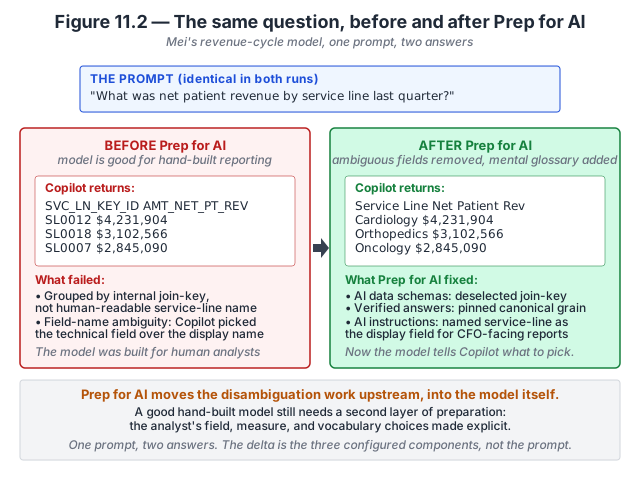
- The three Prep components each fix a specific failure class. Schema simplification hides fields that Copilot mistakes for the intended one; verified answers pin trigger phrases to canonical outputs the analyst has already validated; AI instructions declare the model’s definitional choices and out-of-scope refusals. Skipping any of the three leaves one of the four fixed questions still broken.
- Refused is a valid answer shape. The fifth question (causal) is refused after Prep because the model cannot defensibly answer causal questions from descriptive data. The refusal points the analyst to the descriptive comparison alternatives — a design choice made in the AI-instructions brief, not a Copilot default.
- Prep is not a rebuild. The underlying semantic model is unchanged; the fields, calculations, and relationships that made it good for hand-built reporting are still there. Prep adds a second layer of preparation targeted at Copilot’s failure modes, without touching the model’s hand-built consumers.
- The success metric is failure-shape, not answered-count. After Prep, four out of five worked and one correctly refused. Zero still broken. Chapter 11 walks the discipline in The three components of Prep for AI.
Inspect the trace. All five questions with their before/after verdicts, notes, and the Prep component that closed each gap are available as a flat CSV. Download mei-revenue-cycle.csv · Dataset README and schema.
Try this activity — run Prep for AI on a sandbox model
This activity walks the Mei configuration pattern against a sandbox semantic model. Total time: 60–90 minutes; requires Power BI + Copilot-ready capacity + model-author permission on the target model.
-
Baseline: ask five questions cold. Pick a semantic model your team owns and uses for at least one recurring report. Pick five business questions a leader on the audience side would actually ask (or take Mei’s five from the Ch 11 worked example as a template). Ask each in Copilot’s data-questions surface against the raw, un-Prep’d model. Record the answer and your assessment: defensible / partial / not defensible.
-
Configure AI data schemas. Open Prep data for AI in Power BI Desktop for the target model. Walk Simplify data schema. For each ambiguous field (multiple fields whose names contain the same business word), decide which is the intended answer and deselect the others from Copilot’s view. For each internal-use or staging field, deselect. Save the schema configuration.
-
Configure verified answers. Pin five verified answers — ideally the exact trigger phrases the audience actually uses (not what you think they should say). Map each to a specific visual response. If you do not know the exact phrasings, review real user questions from the last quarter to find them.
-
Author AI instructions. Write the mental-glossary brief covering the disambiguations the cold session in step 1 surfaced. Examples: «When a user asks about revenue, use Net Revenue. The CFO always means net.» «Fiscal-year questions use the FiscalYear column; calendar-year questions use CalendarYear.» Keep it terse; the model reads all of it on every question.
-
Pass 2: re-ask the same five questions in a fresh session. Record the new answers. Compare to step 1: for each question, note which Prep component (if any) changed the answer and whether the answer is now defensible.
-
Diagnose the still-failing questions. For any question still unreliable, name which of the three surviving failure classes applies (unanswerable from the model, BRD-and-presentation, or upstream model problem). Prep-for-AI is not designed to fix all three; correctly diagnosing which is firing is the discipline.
-
Make the call. Write a one-paragraph recommendation to the model owner: which Prep configurations to ship, which to defer, and which questions to redirect to other surfaces (Decomposition Tree for exploration, hand-built reports for high-stakes audit-bound figures). Attach the assembled defensibility bundle for the Prep configuration itself.
-
Reflect (three prompts). Write one sentence in response to each:
- Which of the three Prep components produced the biggest gain in your Pass-2 numbers?
- Which question still failed after Prep, and which of the three surviving failure classes was it?
- How much of your team’s per-question verification time will this Prep configuration save over the next quarter?
The reflection is the activity’s payoff. Skipping it turns the exercise into paperwork.
Need model-author permission or Fabric capacity to run this activity? See Power BI for account setup, licensing, and the Copilot capacity requirements.
Related site resources
- Practice-on-your-own hints: short diagnostic hints for the chapter's independent problems; complete answers are in Appendix G of the Practice Workbook.
- Datasets: any teaching dataset works for the activity above; the ones with the most field-name collisions (CloudRevenue’s multiple revenue fields, M365Marketing’s multiple contribution fields) give the AI-data-schemas step the most to do.
- Prompt Library: includes a confirmation-turn prompt template you can copy directly into a session.
- Chapter 9 companion: the wrong-measure and wrong-grain failure modes from Ch 9 are exactly what a well-Prep’d model prevents.
- Chapter 10 companion: the previous chapter — per-visual verification moves compose with Prep-for-AI (the confirmation turn is the Q&A-surface analogue of the per-visual verification move).
- Chapter 12 companion: the next chapter — dashboard composition, which sits on top of the Prep-for-AI foundation.
Cited in the book
Chapter 11’s bibliography lives in the book’s Appendix C (living version in errata). The chapter’s operative references:
- Microsoft Learn — Prep for AI documentation (AI data schemas, verified answers, AI instructions) URLs above.
- Norman, D. (2013). The Design of Everyday Things (rev. ed.). Basic Books. Confirmation-turn pattern origin.
- Cohen, J. (1988). Statistical Power Analysis for the Behavioral Sciences (2nd ed.). Lawrence Erlbaum. Effect-size reasoning behind why the three-component Prep investment produces disproportionate improvement.